2026 I Inside the Outage: Outage Planning, Turbine Maintenance & Field Service Insights Blog

Inside the Outage:
Power Generation, People & Industry Insights.
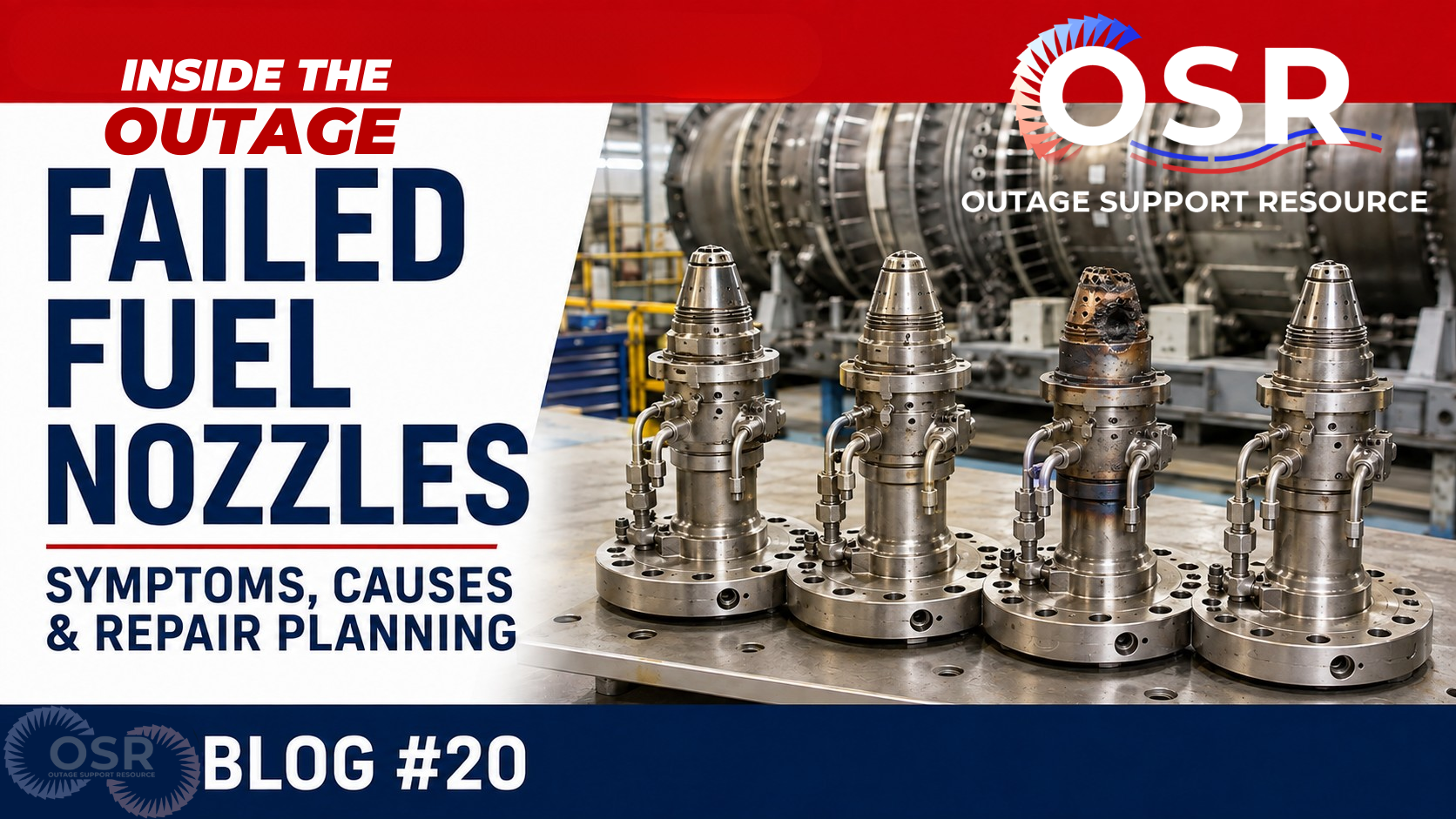
Failed Fuel Nozzles: Symptoms, Causes & Repair Planning
Gas turbine fuel nozzles operate at the center of the combustion process. Their job is to deliver and distribute fuel into the combustor in the correct pattern and quantity so it can mix with air and burn consistently across the machine.
When a nozzle becomes restricted, cracked, eroded, distorted, contaminated, or otherwise damaged, fuel distribution can become uneven. That imbalance may appear as an abnormal exhaust temperature spread, elevated combustion dynamics, emissions changes, startup difficulty, load limitations, or repeat trips. Left unresolved, a fuel nozzle problem can contribute to damage elsewhere in the combustion system and turn a targeted repair into a larger outage.
The key is to recognize the operating clues early, confirm the actual cause, and build the repair scope around evidence rather than assumptions.
What Does a Gas Turbine Fuel Nozzle Do?
A fuel nozzle introduces gas fuel, liquid fuel, or both into the combustion system. Depending on the turbine design, it may include multiple internal passages, premixing circuits, swirlers, tips, orifices, seals, and connections. These features are designed to control fuel flow and help create a stable, repeatable flame pattern.
In dry low-NOx combustion systems, precise fuel-air distribution is especially important. The system must balance emissions performance with flame stability across startup, loading, baseload, turndown, and fuel-transfer conditions.
The U.S. Department of Energy’s NETL Gas Turbine Handbook explains how lean-premixed combustion is used to limit flame temperature and NOx formation, while also noting the combustion-stability challenges associated with low-emissions operation.
A nozzle does not operate alone. Fuel quality, supply pressure, valves, manifolds, controls, combustor hardware, airflow, and turbine operating condition all influence combustion performance. That is why a suspected nozzle failure must be evaluated as part of the complete system.
Common Symptoms of a Failed or Restricted Fuel Nozzle
Fuel nozzle problems do not always produce one unmistakable alarm. Plants may first notice a trend or combination of symptoms, including:
- Increasing exhaust temperature spread
- A persistent hot or cold exhaust thermocouple region
- Elevated or unstable combustion dynamics
- Higher-than-normal NOx or carbon monoxide emissions
- Difficulty maintaining emissions compliance across the normal load range
- Startup trouble, delayed light-off, flame instability, or flameout
- Rough operation during fuel transfer or load changes
- Uneven combustion-can performance
- Reduced output or a restricted operating range
- Increased fuel consumption or declining heat-rate performance
- Combustion alarms, runbacks, trips, or repeat tuning concerns
- Visible nozzle-tip discoloration, cracking, erosion, burning, or deposits during inspection
An exhaust temperature spread can be one of the most useful clues. GE Vernova describes a case in which an abnormal exhaust spread led to an inspection that found debris partially blocking a fuel-nozzle gas passage. After the contamination was removed and its source traced, normal combustion performance returned. The example reinforces an important point: operating data can help direct the inspection, but the hardware still must be examined to verify the cause. See GE Vernova’s Monitoring and Diagnostic Services overview.
What Causes Gas Turbine Fuel Nozzles to Fail?
1. Contamination or Blocked Fuel Passages
Debris, pipe scale, corrosion products, sealant, liquids, or other contamination can restrict a nozzle passage or orifice. Even a partial blockage may change how fuel is divided among the combustion cans or between circuits within one nozzle.
Finding a blocked passage is only part of the repair. The team should also identify where the contamination originated so the same problem does not return after restart.
2. Coke, Carbon, and Deposit Buildup
Liquid-fuel operation, poor atomization, improper purging, fuel-quality problems, or localized overheating can leave deposits on the nozzle tip or within internal passages. Deposits may distort the spray pattern, restrict flow, or interfere with mixing.
3. Cracking and Thermal Fatigue
Fuel nozzle components experience repeated heating and cooling cycles. Over time, thermal strain can initiate cracking in nozzle tips, welds, braze joints, swirlers, and other high-temperature features. GE Vernova’s technical paper on Gas Turbine Emissions and Control discusses how thermal strain in certain water-injected fuel-nozzle configurations can lead to cracking and shorter combustion-inspection intervals.
4. Erosion, Burning, or Material Loss
High-velocity flow, contamination, flame contact, overheating, or long service exposure can erode or burn nozzle features. Changes to hole size, edge condition, or tip geometry can alter fuel delivery and the local flame pattern.
5. Foreign-Object Damage
Loose material introduced during maintenance or debris carried through the fuel system can damage delicate nozzle features. Strict foreign-material-exclusion practices are essential whenever fuel-system and combustion hardware is open.
6. Improper Assembly or Installation
Incorrect orientation, damaged sealing surfaces, reused seals where replacement is required, improper torque, misconnected fuel circuits, or installation damage can create leakage or uneven fuel delivery. A nozzle that appears acceptable on the bench may still perform poorly if it is installed incorrectly.
7. Fuel-Quality or Fuel-Condition Changes
Changes in heating value, specific gravity, temperature, pressure, moisture, or contamination can affect combustion behavior. GE Vernova notes that rapid fuel variability may contribute to high acoustics, flameouts, high emissions, and trips on applicable units. More information is available in its Fuel Condition Monitoring overview.
Fuel-condition problems can look like nozzle problems—and may also contribute to nozzle distress—so both should be considered during troubleshooting.
8. Abnormal Combustion Dynamics
Combustion dynamics are pressure oscillations created by interactions between heat release, fuel-air mixing, and the combustor’s acoustic behavior. When dynamics remain elevated, vibration can damage combustion hardware. DOE research on commercial-scale gas turbine fuel nozzles and combustion oscillations notes that even relatively small pressure oscillations can damage hardware.
The nozzle may be the source of poor fuel distribution, a victim of sustained dynamics, or both. Replacing damaged hardware without resolving the dynamics may allow the problem to repeat.
9. Normal Wear and Service Exposure
Fuel nozzle tips and related combustion hardware are wear items. GE Vernova identifies fuel-nozzle-tip wear as one of the combustion-system conditions addressed in its Combustion Interval Extension offering. Inspection intervals, operating profile, starts, fuel type, and unit history should all be considered when assessing remaining serviceability.
Why Failed Fuel Nozzles Matter
Uneven Combustion and Exhaust Temperature Spreads
If one nozzle delivers more or less fuel than intended, combustion temperature can vary around the turbine. The exhaust-temperature pattern may reveal the imbalance, but its position at the exhaust does not always map directly to a single nozzle without considering the machine’s flow path and OEM diagnostic method.
Combustion Dynamics and Hardware Damage
Poor fuel-air mixing can increase combustion instability. Sustained dynamics may accelerate cracking, fretting, wear, and damage in fuel nozzles, liners, transition pieces, crossfire components, and mounting hardware.
Emissions Excursions
Uneven or unstable combustion can affect NOx and carbon monoxide emissions. A unit may remain online yet lose part of its emissions-compliant operating range, limiting turndown or maximum load.
Startup and Reliability Problems
A damaged or restricted nozzle may contribute to poor light-off, unstable flame, flame detection issues, fuel-transfer difficulty, runbacks, or trips. These problems can delay a startup and place the outage schedule at risk.
Downstream Hot-Gas-Path Risk
Localized over-fueling or an abnormal flame pattern can expose downstream components to uneven temperatures. If the condition persists, the repair scope may expand beyond the nozzle and combustion hardware.
Lost Capacity and Higher Outage Cost
When a plant must operate at reduced load, remain outside a preferred operating range, or shut down unexpectedly, the cost may extend well beyond the replacement part. Lost generation, additional inspections, expedited parts, specialized labor, and schedule disruption can quickly increase the impact.
How Failed Fuel Nozzles Are Diagnosed
A strong troubleshooting plan combines operating data with hands-on inspection. Depending on the turbine and symptoms, the evaluation may include:
- Reviewing exhaust temperature spreads and individual thermocouple trends
- Comparing combustion-dynamics amplitude and frequency data
- Reviewing NOx, CO, fuel flow, load, and tuning history
- Determining whether symptoms appear during startup, transfer, loading, baseload, or turndown
- Checking gas-fuel pressure, fuel quality, filters, valves, manifolds, drains, and purge systems
- Performing a borescope inspection of accessible combustion and hot-gas-path areas
- Removing and visually inspecting fuel nozzles
- Inspecting nozzle tips, swirlers, orifices, welds, braze joints, seals, and connection points
- Checking for blockage, deposits, cracking, burning, erosion, distortion, fretting, or leakage
- Verifying flow or spray characteristics through an appropriate qualified facility when required
- Comparing nozzle condition and test results across the full set
- Reviewing prior repair history, service hours, starts, and repeat findings
The entire nozzle set should be considered. One visibly damaged component may identify the immediate issue, but comparison across all cans can reveal a broader fuel-system, dynamics, or maintenance problem.
What Should Be Inspected During the Outage?
Once the unit is safely isolated and the combustion system is accessible, the team should document the as-found condition before cleaning or disassembly removes valuable evidence.
Inspection priorities may include:
- Nozzle position and orientation
- Fuel connections, seals, and signs of external leakage
- Tip condition, color, deposits, cracks, erosion, and evidence of overheating
- Premixer and swirler condition
- Internal passages and orifices, using approved methods
- Mounting hardware, contact surfaces, and evidence of movement or fretting
- Combustion liner, cap, transition piece, crossfire, and support condition
- Evidence of flame impingement or unusual temperature exposure
- Foreign material or contamination in manifolds and supply piping
- Borescope findings downstream of the affected combustion area
Photographs, component locations, serial numbers, measurements, and inspection results should be recorded carefully. Good documentation helps engineering and plant personnel determine whether the correct action is cleaning, qualified repair, component replacement, additional testing, or a larger combustion-system inspection.
Fuel Nozzle Repair and Replacement Planning
The repair scope should follow the inspection findings and the applicable OEM criteria. Possible actions include:
- Cleaning approved fuel passages and nozzle surfaces
- Removing deposits or contamination using an approved process
- Flow testing or spray-pattern testing, where applicable
- Replacing seals, gaskets, and specified hardware
- Sending nozzles to a qualified repair facility for detailed inspection and repair
- Replacing one nozzle or a complete matched set, as required by the design and findings
- Correcting fuel-supply contamination, filter, manifold, purge, valve, or control problems
- Inspecting associated combustion components for collateral damage
- Addressing combustion-dynamics or tuning conditions before returning the unit to long-term service
- Completing post-maintenance leak checks, operational checks, and tuning with qualified personnel
Fuel nozzle repair is not simply a matter of making the component look clean. Internal flow distribution, dimensions, materials, coatings, joints, and tip geometry may all affect performance. Any repair or testing should follow the applicable technical requirements and be completed by qualified personnel.
Can a Suspected Fuel Nozzle Problem Wait?
That decision depends on the severity and trend of the condition. A small, stable exhaust spread with no dynamics, emissions, or reliability impact may be managed differently than a rapidly increasing spread accompanied by high dynamics, visible damage, repeated alarms, or trips.
Plant operations, engineering, and the OEM or other authorized technical authority should evaluate the unit-specific data and operating limits. Conditions that warrant prompt escalation may include:
- A rapid or unexplained change in exhaust spread
- High or increasing combustion dynamics
- Repeated flame loss, startup failure, runback, or trip
- Emissions outside permitted or expected limits
- Evidence of fuel leakage
- Suspected burning, cracking, or material loss
- Signs that downstream hardware may be exposed to abnormal temperature
If the unit remains in service, the plant should define monitoring frequency, alarm response, operating restrictions, and clear shutdown or escalation criteria.
How Plants Can Reduce Repeat Fuel Nozzle Problems
- Trend exhaust spreads, dynamics, emissions, and fuel-system data instead of relying on isolated readings.
- Review changes after startups, fuel transfers, tuning adjustments, and maintenance.
- Maintain fuel filtration, conditioning, drains, and purge systems.
- Use strong foreign-material-exclusion controls whenever the system is open.
- Protect nozzle tips and sealing surfaces during removal, handling, transport, and installation.
- Record each nozzle’s location and as-found condition.
- Follow correct cleaning, inspection, assembly, torque, and leak-check procedures.
- Investigate repeat damage for a common cause such as contamination, dynamics, fuel variability, or installation error.
- Inspect related combustion hardware rather than treating the failed nozzle as an isolated component.
OSR Gas Turbine Fuel Nozzle and Combustion Support
Outage Support Resource supports planned and emergent gas turbine outages, including combustion inspections, fuel nozzle removal and installation, fuel nozzle swaps, combustion hardware inspection, borescope support, and mechanical field services across major utility and industrial turbine fleets.
Our field teams work with plant personnel, engineering resources, OEM requirements, and qualified repair providers to document the condition, protect critical hardware, complete the defined mechanical scope, and help prepare the unit for a safe return to service.
If your gas turbine is showing abnormal exhaust spreads, combustion instability, startup problems, emissions changes, or suspected fuel nozzle damage, OSR is ready to support the inspection and outage plan.
If it turns, burns, or leaks… we are The Solution.
Contact Outage Support Resource today to discuss your fuel nozzle inspection, combustion outage, or emergent field-service needs.
Frequently Asked Questions About Failed Gas Turbine Fuel Nozzles
What are the most common signs of a failed gas turbine fuel nozzle?
Common signs include abnormal exhaust temperature spreads, elevated combustion dynamics, emissions changes, difficult startup, unstable flame, load restrictions, repeat alarms, or visible cracking, deposits, erosion, burning, and blockage found during inspection.
Can a clogged fuel nozzle cause a high exhaust-temperature spread?
Yes. A partially blocked nozzle or passage can change fuel distribution among combustion cans, producing hot and cold regions in the exhaust-temperature pattern. The complete fuel and combustion system should still be evaluated before assigning the cause to one nozzle.
Can a bad fuel nozzle increase NOx or CO emissions?
Yes. Fuel nozzles help establish the fuel-air mixture and flame pattern. Poor distribution or unstable combustion can affect flame temperature and combustion completeness, which may change NOx or carbon monoxide emissions.
Can failed fuel nozzles damage other turbine components?
They can contribute to uneven temperatures, elevated dynamics, or abnormal flame patterns that place additional stress on combustion and downstream hot-gas-path hardware. The surrounding components should be inspected when significant nozzle damage is found.
Should one failed nozzle or the entire set be replaced?
The answer depends on turbine design, component condition, flow-test results, service history, and applicable OEM requirements. Inspecting and comparing the complete set helps determine whether the problem is isolated or system-wide.
Can fuel nozzles be repaired?
Some fuel nozzles can be cleaned, tested, or repaired by qualified facilities using approved specifications and processes. Others may require replacement. Field appearance alone is not enough to establish serviceability.
What should be checked before restarting after fuel nozzle work?
- The required checks depend on the unit but may include assembly verification, connection and seal checks, foreign-material-exclusion closeout, fuel-system leak testing, controls verification, borescope confirmation, startup monitoring, emissions review, dynamics monitoring, and tuning by qualified personnel.




Outage Support Resource (OSR) provides expert field service solutions for power plants, LNG facilities, and petrochemical operations. Our services include turbine maintenance, outage planning, millwright services, refinery turnarounds, and emergency field service response.
With experienced crews and rapid mobilization, OSR supports critical infrastructure across the United States and Gulf Coast, helping reduce downtime, improve reliability, and execute outages with precision.
Key Words:
power plant outage planning, turbine maintenance, outage support services, refinery turnaround services, LNG plant maintenance, gas turbine inspection, steam turbine maintenance, generator maintenance services, industrial field service, rotating equipment maintenance, millwright services, outage planning checklist, turnaround maintenance planning, plant shutdown support, forced outage response, scheduled outage services, power generation maintenance, combined cycle plant maintenance, petrochemical maintenance services, reliability engineering, preventative maintenance planning, OSR outage support resource, field service technicians, turbine overhaul support, compressor inspection services