2026 I Inside the Outage: Outage Planning, Turbine Maintenance & Field Service Insights Blog
Inside the Outage:
Power Generation, People & Industry Insights.
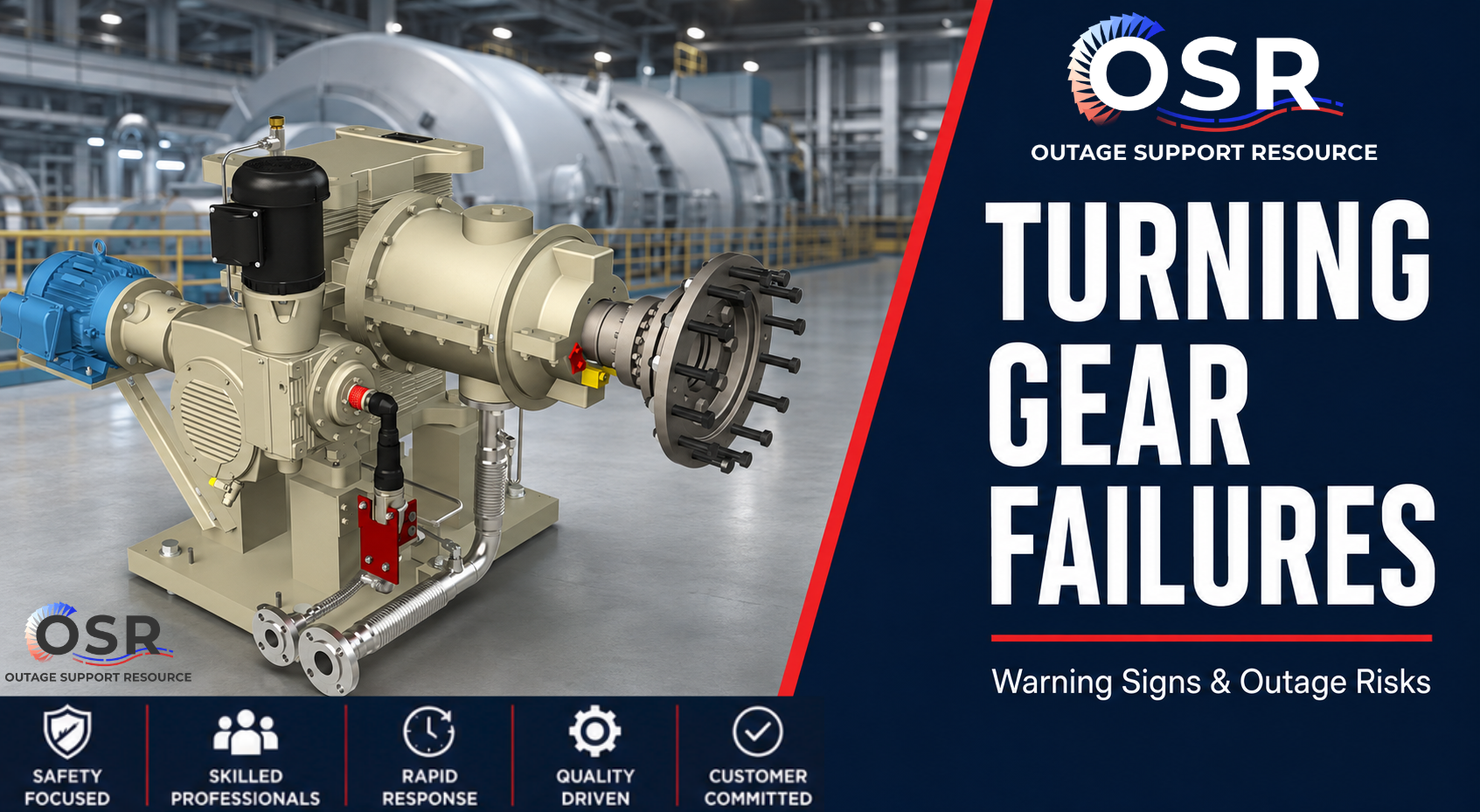
Turning Gear Failures: Warning Signs and Outage Risks
A turbine turning gear may operate only during startup, shutdown, cooldown, and maintenance, but its job is critical.
The turning gear, sometimes called a barring gear, slowly rotates the turbine-generator rotor while the unit is offline. This controlled rotation helps the rotor heat and cool evenly, reducing the risk of thermal bowing and maintaining proper clearances between rotating and stationary components.
When a turning gear fails, the consequences can extend far beyond the turning gear assembly itself. A failure during a hot shutdown can contribute to rotor bow, elevated eccentricity, internal rubbing, startup vibration, and an extended outage.
Recognizing the warning signs early gives plant teams an opportunity to inspect and correct the problem before it affects the turbine’s return to service.
What Does a Turbine Turning Gear Do?
Large turbine rotors remain extremely hot after shutdown. If the rotor remains stationary while cooling, the upper and lower portions may cool at different rates. This uneven temperature distribution can cause temporary thermal bowing.
The turning gear rotates the rotor at a slow, controlled speed during cooldown and warm-up. This helps:
- Promote more uniform rotor temperatures
- Reduce temporary thermal bowing
- Maintain rotor straightness and internal clearances
- Support safe turbine startup
- Position the rotor during inspections and maintenance
- Reduce the risk of rubs caused by excessive eccentricity
The Electric Power Research Institute explains that slow rotor rotation helps maintain a more uniform internal temperature distribution and reduces the likelihood of thermal-stress damage during startup and shutdown.
Warning Signs of a Turning Gear Problem
Turning gear problems do not always begin with a complete failure. Many systems show mechanical, electrical, lubrication, or control-related warning signs first.
1. Failure to Engage
The turning gear may not engage automatically after the turbine coasts down, or it may fail to engage during a manual command.
Possible causes include:
- Electrical control or motor problems
- Faulty permissives or interlocks
- Low lubrication or jacking-oil pressure
- Binding in the engagement mechanism
- Damaged clutch or pinion components
- Improper gear alignment
- Excessive rotor resistance
A failure-to-engage alarm should never be treated as only an instrumentation issue until actual rotor movement has been verified.
2. Irregular or Intermittent Rotor Movement
The rotor should turn smoothly at the speed specified by the OEM. Starting, stopping, hesitation, or inconsistent movement can indicate:
- Gear-tooth wear or damage
- Improper gear mesh
- A binding engagement mechanism
- Motor or electrical problems
- Inadequate lubrication
- Abnormal resistance within the turbine train
Intermittent movement can allow uneven cooling even if the system has not completely stopped.
3. Abnormal Noise
Grinding, knocking, clicking, or scraping from the turning gear assembly can signal mechanical distress.
Potential sources include:
- Damaged pinion or bull-gear teeth
- Insufficient backlash
- Worn bearings
- Loose hardware
- Gearbox damage
- Misalignment
- Improper clutch engagement
A changing sound is especially important when accompanied by unstable speed, elevated motor current, or vibration.
4. Increased Motor Current
A turning gear motor drawing more current than normal may be working against additional resistance.
This can result from:
- A mechanically bound rotor
- Inadequate bearing lubrication
- Misaligned gearing
- Damaged bearings or gear teeth
- Internal turbine rubbing
- Thermal bowing
- A partially engaged clutch
Operators should compare the reading with the unit’s normal operating history and OEM limits.
5. Gearbox Oil Problems
Low oil level, contaminated lubricant, metal particles, abnormal oil temperature, or evidence of leakage can indicate developing gearbox damage.
Lubrication problems can accelerate wear of:
- Bearings
- Shafts
- Reduction gears
- Pinions
- Clutches
- Engagement components
Oil condition and debris can provide valuable early evidence before a visible mechanical failure occurs.
6. Elevated Rotor Eccentricity
Abnormal eccentricity during turning-gear operation or slow roll may indicate that the rotor is not remaining straight during cooldown or warm-up.
A thermally bowed rotor may also produce elevated vibration as the turbine is rolled off the turning gear. Attempting to accelerate a turbine when eccentricity or vibration remains outside acceptable limits can increase the risk of internal rubbing and component damage.
7. Failure to Disengage
The turning gear must properly disengage as the turbine begins accelerating.
A clutch, pinion, or control problem that prevents disengagement may damage the turning gear and interfere with the startup sequence. Engagement and disengagement indications should be confirmed before proceeding.
Common Causes of Turning Gear Failures
Turning gear failures may involve one component or several connected systems. Common causes include:
- Gear, pinion, or clutch wear
- Improper gear backlash
- Shaft or coupling misalignment
- Contaminated or inadequate lubrication
- Worn motor or gearbox bearings
- Electrical motor or starter failure
- Faulty switches, sensors, or interlocks
- Improper assembly after maintenance
- Loose mounting hardware
- Hydraulic or pneumatic engagement problems
- Attempting to turn a mechanically restricted rotor
- Internal turbine rubbing or binding
The turning gear should not be assumed to be the root cause simply because the rotor will not turn. The resistance could originate elsewhere in the turbine-generator train.
How Turning Gear Failure Can Affect an Outage
A turning gear problem can quickly become an outage-critical event.
Rotor Bow and Startup Vibration
If a hot rotor stops turning, uneven cooling can produce temporary thermal bow. Depending on the turbine’s condition and temperature, additional cooldown or extended turning time may be required before eccentricity returns to an acceptable range.
Internal Rubbing
A bowed or improperly positioned rotor can reduce internal clearances. Attempting a startup under these conditions may lead to contact involving seals, packing, blades, or other stationary components.
Delayed Restart
Before the unit can safely restart, the plant may need to determine:
- Why the turning gear failed
- Whether the rotor turns freely
- Whether eccentricity is acceptable
- Whether internal rubbing occurred
- Whether lubrication systems operated correctly
- Whether the gear, clutch, motor, or controls require repair
These checks can extend the outage even when the original maintenance scope has already been completed.
Additional Inspection and Repair
Depending on the failure, the work may involve:
- Turning gear disassembly
- Gear and bearing inspection
- Backlash and contact-pattern checks
- Motor testing
- Alignment verification
- Clutch or engagement-mechanism repairs
- Lubrication-system inspection
- Manual rotor movement under an approved procedure
- Borescope or internal turbine inspection
- Eccentricity and vibration review
What Should Be Inspected?
The exact inspection scope should follow the turbine manufacturer’s procedures and the plant’s safety requirements. Common inspection points include:
- Turning gear motor and electrical supply
- Starter, breakers, relays, and controls
- Engagement and disengagement switches
- Permissives and interlocks
- Gearbox oil level and condition
- Pinion and bull-gear tooth condition
- Gear backlash and contact pattern
- Bearings, shafts, keys, and couplings
- Clutch or engagement mechanism
- Mounting hardware and alignment
- Lubrication and jacking-oil systems
- Rotor eccentricity and vibration history
Operators should not repeatedly cycle the turning gear or force a rotor to move without identifying the source of resistance. EPRI cautions that a locked rotor should not be forced with the turning gear or steam because extensive turbine damage may result.
Reduce the Risk Before the Next Startup
Turning gear operation should be included in outage planning—not treated as a minor auxiliary system.
Before returning a turbine to service, teams should confirm that:
- The rotor turns smoothly
- Gear engagement is complete
- Lubrication and jacking-oil systems are available
- Turning speed is stable
- Current draw is within the expected range
- Engagement and disengagement indications are correct
- Eccentricity and vibration meet OEM requirements
- No abnormal noise or mechanical interference is present
OSR Turbine and Generator Field Support
Outage Support Resource provides experienced turbine, generator, balance-of-plant, and mechanical field-service support for planned outages, emergent repairs, inspections, troubleshooting, and supplemental outage manpower.
When a turning gear problem threatens a shutdown, cooldown, or startup schedule, OSR can help support the mechanical inspection and repair scope while coordinating with plant personnel, engineering, and the applicable OEM procedures.
If it turns, burns, or leaks… OSR is The Solution.
Contact Outage Support Resource to discuss your upcoming turbine outage or emergent field-service needs.

Outage Support Resource (OSR) provides expert field service solutions for power plants, LNG facilities, and petrochemical operations. Our services include turbine maintenance, outage planning, millwright services, refinery turnarounds, and emergency field service response.
With experienced crews and rapid mobilization, OSR supports critical infrastructure across the United States and Gulf Coast, helping reduce downtime, improve reliability, and execute outages with precision.
Key Words:
power plant outage planning, turbine maintenance, outage support services, refinery turnaround services, LNG plant maintenance, gas turbine inspection, steam turbine maintenance, generator maintenance services, industrial field service, rotating equipment maintenance, millwright services, outage planning checklist, turnaround maintenance planning, plant shutdown support, forced outage response, scheduled outage services, power generation maintenance, combined cycle plant maintenance, petrochemical maintenance services, reliability engineering, preventative maintenance planning, OSR outage support resource, field service technicians, turbine overhaul support, compressor inspection services