2026 I Inside the Outage: Outage Planning, Turbine Maintenance & Field Service Insights Blog

Inside the Outage:
Power Generation, People & Industry Insights.
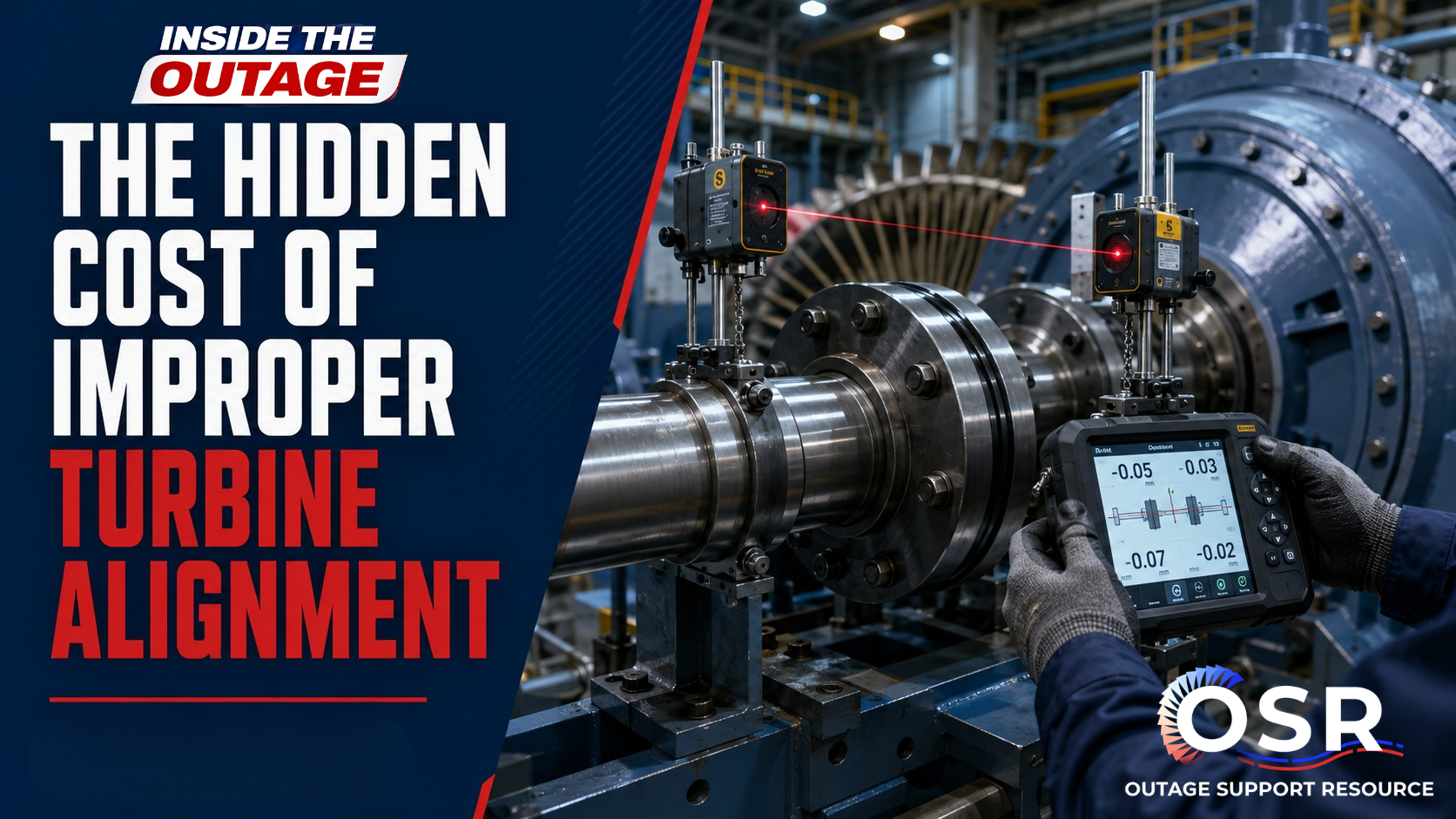
The Hidden Cost of Improper Turbine Alignment
Turbine alignment is measured in thousandths of an inch, but the consequences of getting it wrong can be measured in lost megawatts, damaged components, extended outages, and unplanned repair costs.
A turbine-generator train is designed to operate as one precisely aligned system. The turbine, generator, couplings, bearings, and supporting components must remain positioned within the unit’s approved tolerances under both static and operating conditions. When that relationship changes, forces that should travel smoothly through the shaft train can be redirected into bearings, seals, couplings, and other critical components.
Improper turbine alignment may not cause an immediate trip. In many cases, the unit continues to operate while vibration, heat, wear, and efficiency losses slowly increase. That is what makes misalignment so costly: the first visible symptom may be only a small indication of a much larger developing problem.
What Is Turbine Misalignment?
Turbine misalignment occurs when the rotational centerlines of connected equipment are not positioned correctly according to the applicable OEM requirements and the unit’s expected operating condition.
Common alignment conditions include:
- Offset misalignment: Shaft centerlines are parallel but displaced from one another.
- Angular misalignment: Shaft centerlines meet at an angle rather than remaining collinear.
- Combined misalignment: Both offset and angular error are present.
- Internal alignment error: Bearings, diaphragms, seals, or other stationary components are not properly positioned relative to the rotor.
- Thermal alignment error: The cold alignment does not correctly account for movement as the unit heats and reaches operating temperature.
Proper alignment is more than placing two coupling faces within tolerance. It requires an understanding of the complete turbine-generator train, bearing elevations, rotor position, casing condition, thermal growth, piping forces, foundation behavior, and the unit’s maintenance history.
What Causes Turbine Alignment to Change?
Alignment can shift gradually during operation or be introduced during maintenance. Common causes include:
- Incorrect installation or reassembly
- Failure to account for thermal growth
- Foundation settling or grout deterioration
- Soft foot or uneven equipment support
- Bearing wear or improper bearing elevation
- Loose, damaged, or incorrectly fitted hold-down hardware
- Casing distortion
- Excessive or uneven pipe strain
- Coupling wear or incorrect coupling installation
- Rotor work, component replacement, or major outage activity
- Incomplete or inaccurate dimensional records
- Improper jacking, lifting, or casing closure practices
Because several conditions can create similar symptoms, alignment should be evaluated as part of the entire mechanical system—not treated as an isolated coupling adjustment.
Warning Signs of Improper Turbine Alignment
Misalignment does not always present the same way. Operations and maintenance teams should pay close attention to:
- Increasing or abnormal shaft vibration
- A change in vibration after an outage or repair
- Elevated bearing metal or oil temperatures
- Recurring bearing wear
- Uneven coupling wear
- Seal rubs or increased seal leakage
- Abnormal axial position or thrust bearing behavior
- Oil leaks related to bearing or seal distress
- Unusual noise during startup, shutdown, or load changes
- Difficulty achieving expected output or efficiency
- Repeated balancing attempts that do not resolve the underlying vibration
- Changes that occur as the unit warms or load increases
No single symptom proves that a unit is misaligned. However, a combination of these conditions—or a repeat problem following recent maintenance—should prompt a detailed inspection.
The Hidden Costs of Improper Alignment
1. Accelerated Bearing Damage
Misalignment can change bearing loading and create uneven contact, higher temperatures, or unstable shaft behavior. A problem that begins as a small alignment error may eventually lead to wiped bearings, damaged journals, or an unexpected shutdown.
2. Increased Vibration
Misalignment is a common contributor to vibration, but it can sometimes be mistaken for imbalance. If weight is added to correct a vibration problem caused by alignment, the true cause remains and additional complications may be introduced.
3. Seal and Packing Wear
When the rotor is not centered correctly through stationary components, clearances may become uneven. This can increase the risk of rubbing, seal damage, packing wear, and leakage.
4. Coupling and Shaft-Train Stress
Flexible couplings can accommodate limited movement, but they are not intended to correct a poorly aligned machine train. Continuous misalignment can increase coupling forces and transmit stress into connected equipment.
5. Lost Efficiency and Output
Additional friction, leakage, vibration, and mechanical drag consume energy that should be converted into useful output. Even when the unit remains available, it may not be operating as efficiently as it should.
6. Longer and More Expensive Outages
Alignment problems discovered late in an outage can affect critical-path work. Crews may need to reopen components, repeat measurements, correct supports, or wait for repair decisions. If the condition is missed completely, the plant may face a forced outage after returning to service.
Why Cold Alignment Alone Is Not Enough
A turbine does not remain in the same physical position from cold shutdown to full-load operation. Casings, rotors, bearings, supports, and connected piping move as temperatures change.
For that reason, cold alignment targets must account for expected thermal growth. A train that appears perfectly aligned while offline may move outside acceptable operating alignment if the correct growth targets were not used—or if field conditions no longer match the assumptions behind those targets.
Historical readings, OEM criteria, bearing elevations, casing temperatures, support condition, and operating data should all be considered when developing or confirming the alignment plan.
How Turbine Alignment Is Evaluated
Depending on the unit and scope, a thorough evaluation may include:
- Review of vibration trends, temperatures, and operating history
- Verification of coupling condition and runout
- Shaft alignment measurements using appropriate precision methods
- Bearing elevation and centerline checks
- Rotor position and clearance verification
- Soft-foot and support checks
- Foundation, grout, and hold-down inspection
- Pipe-strain evaluation
- Casing and diaphragm alignment checks
- Review of thermal-growth targets
- Final documentation of as-found, corrected, and as-left conditions
Laser systems are valuable tools, but the instrument does not replace sound turbine knowledge. Accurate results depend on proper setup, stable measurement conditions, correct target values, repeatable readings, and experienced interpretation.
Preventing Alignment Problems During an Outage
The best time to protect alignment is before components are disassembled.
An effective outage plan should include:
- Recording reliable as-found dimensions and coupling readings.
- Documenting bearing positions, shims, clearances, and casing conditions.
- Protecting reference points throughout the outage.
- Tracking repairs or component changes that may affect the shaft train.
- Verifying supports, hold-downs, grout, and piping conditions.
- Using calibrated equipment and repeatable measurement practices.
- Comparing results with OEM requirements and the unit’s history.
- Completing final alignment checks before the work becomes difficult to reverse.
Good records matter. They allow the team to identify what changed, confirm the completed work, and provide a valuable baseline for future outages.
When Should a Plant Schedule an Alignment Inspection?
An alignment evaluation should be considered when:
- Vibration or bearing temperatures begin trending upward
- Bearings or seals experience recurring damage
- The turbine or generator has been moved
- Couplings, bearings, rotors, or major casings have been serviced
- Foundation or support problems are suspected
- Piping modifications may have introduced strain
- A unit behaves differently after an outage
- A major inspection or overhaul is already planned
Early investigation gives the plant more options. Waiting until a trip or component failure often turns a correctable condition into a larger repair.
OSR: Precision Where It Matters
Outage Support Resource supports turbine-generator inspections, maintenance, overhaul, alignment, and field repairs for power-generation and industrial facilities. Our experienced teams understand that successful alignment requires more than a final reading—it requires disciplined measurements, careful assembly, clear documentation, and attention to the entire machine train.
If your unit is experiencing unexplained vibration, recurring bearing or seal problems, or alignment concerns following an outage, OSR is ready to help identify the problem and develop the right path forward.
If it turns, burns, or leaks… we are The Solution.
Contact Outage Support Resource today to discuss your turbine alignment or upcoming outage needs.
Frequently Asked Questions
Can a turbine run while misaligned?
Yes. A turbine may continue operating with some degree of misalignment, but vibration, heat, wear, and component stress can increase over time. Continued operation should be evaluated using operating data, inspection findings, OEM limits, and qualified engineering guidance.
Can misalignment look like rotor imbalance?
Yes. Both conditions can contribute to vibration. Vibration phase, amplitude, operating response, mechanical inspection findings, and alignment measurements should be considered before corrective action is selected.
How often should turbine alignment be checked?
There is no single interval for every unit. Alignment is commonly verified during major maintenance, after the shaft train or supporting components have been disturbed, and whenever operating symptoms suggest a possible change.
What is the difference between turbine alignment and balancing?
Alignment positions the rotational centerlines and related components correctly. Balancing corrects uneven mass distribution in the rotating element. One cannot reliably substitute for the other.
Suggested Internal Links
- Turbine inspection and overhaul services
- Turbine vibration troubleshooting
- Planned and emergency outage support
- Contact OSR


Outage Support Resource (OSR) provides expert field service solutions for power plants, LNG facilities, and petrochemical operations. Our services include turbine maintenance, outage planning, millwright services, refinery turnarounds, and emergency field service response.
With experienced crews and rapid mobilization, OSR supports critical infrastructure across the United States and Gulf Coast, helping reduce downtime, improve reliability, and execute outages with precision.
Key Words:
power plant outage planning, turbine maintenance, outage support services, refinery turnaround services, LNG plant maintenance, gas turbine inspection, steam turbine maintenance, generator maintenance services, industrial field service, rotating equipment maintenance, millwright services, outage planning checklist, turnaround maintenance planning, plant shutdown support, forced outage response, scheduled outage services, power generation maintenance, combined cycle plant maintenance, petrochemical maintenance services, reliability engineering, preventative maintenance planning, OSR outage support resource, field service technicians, turbine overhaul support, compressor inspection services