2026 I Inside the Outage: Outage Planning, Turbine Maintenance & Field Service Insights Blog
Inside the Outage:
Power Generation, People & Industry Insights.
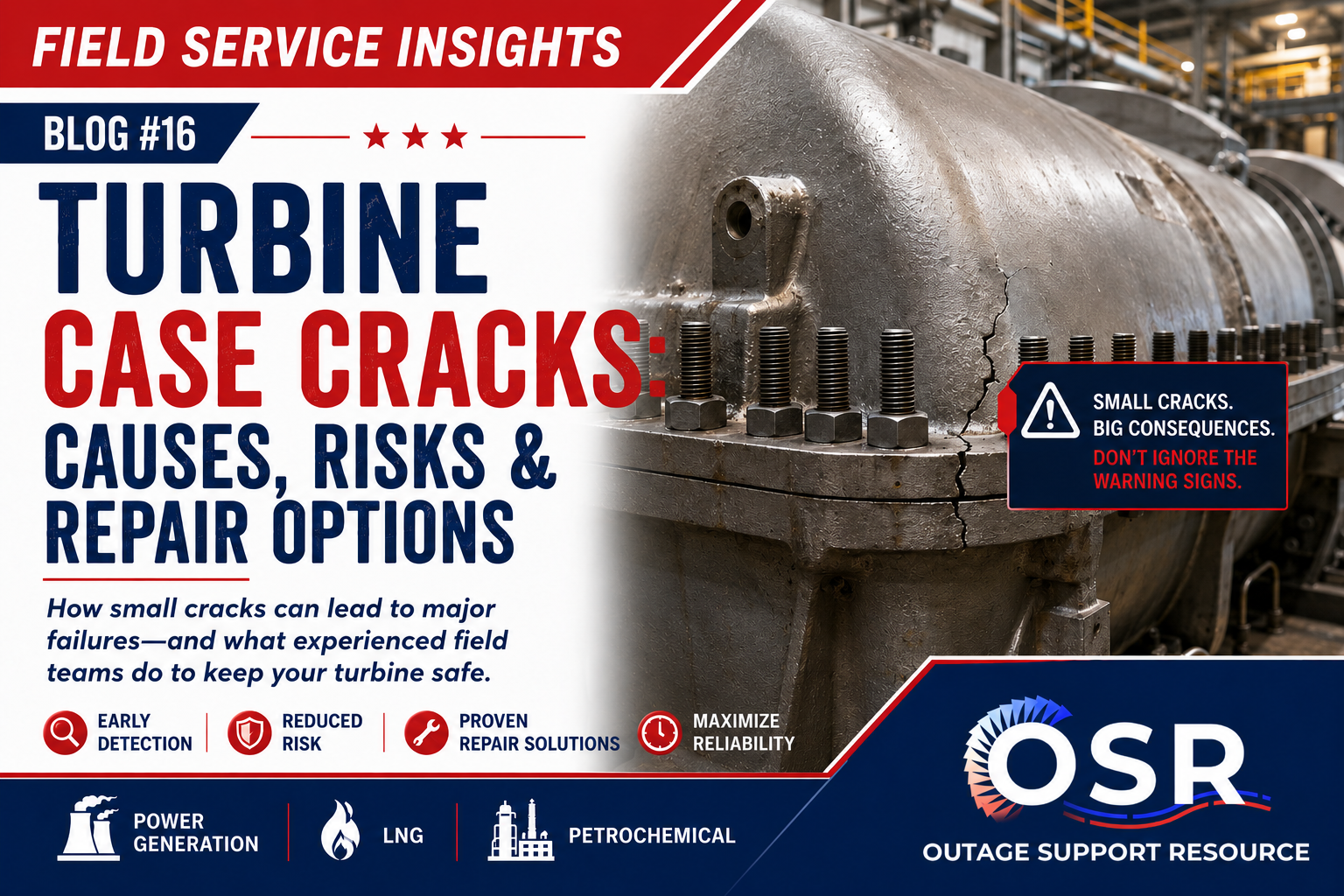
Turbine Case Cracks: Causes, Risks & Repair Options
A small crack in a turbine casing may not look like an emergency, but in an environment where equipment operates under extreme temperatures, pressure, vibration, and repeated thermal cycles, a small crack deserves serious attention.
Turbine casing cracks can develop gradually over years of operation or appear following abnormal operating conditions, maintenance events, or repeated startups and shutdowns. If the underlying cause isn't identified, cracking may continue to propagate and eventually contribute to leakage, distortion, clearance issues, reduced reliability, or a larger mechanical failure.
For power generation and industrial facilities, finding casing damage during a planned inspection provides something extremely valuable: time to evaluate the problem before it becomes an unplanned outage.
Understanding why turbine cases crack—and knowing what to do when one is discovered—is an important part of maintaining reliable rotating equipment.
What Is a Turbine Case?
The turbine casing is the heavy structural enclosure surrounding critical internal turbine components.
Depending on the machine, the casing helps support and maintain the position of components while containing the operating environment surrounding the turbine's internal sections.
Because the casing must maintain precise relationships with internal rotating components, changes in its condition can affect much more than the case itself.
Cracking, distortion, damaged joint surfaces, or other casing problems may influence:
- Internal clearances
- Sealing
- Alignment
- Vibration
- Thermal expansion
- Equipment reliability
That is why casing condition should be carefully evaluated during major inspections and outages.
What Causes Turbine Case Cracks?
There isn't one universal cause.
In many cases, cracking develops from a combination of operating conditions, equipment age, thermal cycling, mechanical stress, and previous repair history.
1. Thermal Cycling
Turbines repeatedly transition between ambient and extremely high operating temperatures. Every startup heats components. Every shutdown allows them to cool. As the casing expands and contracts through repeated operating cycles, thermal stresses develop within the material. Over years of service, areas exposed to concentrated stress may become increasingly susceptible to cracking. Plants that experience frequent starts and stops may subject turbine components to considerably more thermal cycling than units that operate continuously.
2. Uneven Heating and Cooling
Uniform thermal expansion is important. If one area of a turbine casing heats or cools substantially faster than another, different sections of the casing attempt to expand or contract at different rates. That difference can create significant localized stress.
Potential contributors include:
- Aggressive startup procedures
- Rapid shutdown conditions
- Uneven cooling
- Abnormal operating events
- Changes in airflow or combustion conditions
Repeated thermal stress can eventually contribute to cracking or casing distortion.
3. Excessive Vibration
Vibration doesn't only affect bearings and rotating components. Continuous mechanical vibration can also place stress on stationary structures, joints, supports, and casing components. If a turbine is experiencing vibration caused by misalignment, rotor imbalance, bearing problems, or another mechanical condition, the resulting forces may contribute to fatigue over time. A casing crack therefore shouldn't always be treated as an isolated problem. The field team should also consider what operating condition may have contributed to it.
4. Mechanical Stress
Turbine cases experience significant mechanical loads. Improper assembly, uneven bolt loading, piping strain, alignment issues, or distorted mating surfaces can introduce stresses that weren't intended in the original design. Over time, concentrated mechanical stress can contribute to cracking—particularly around areas where geometry already creates natural stress concentrations.
5. Previous Repairs
Repair history matters. A previously repaired crack should receive careful attention during future inspections.
The important questions aren't simply:
Did the repair hold?
They are also:
Why did the original crack occur?
Has it continued to propagate?
Has another crack developed nearby?
If the underlying mechanical or thermal condition remains, repairing the visible damage may not eliminate the actual problem.
Where Are Turbine Case Cracks Commonly Found?
Cracking may develop around areas subjected to concentrated thermal or mechanical stress.
Depending on turbine design, inspection teams may pay particular attention to areas around:
- Bolt holes
- Flanges
- Horizontal joints
- Structural transitions
- Welded areas
- Previous repair locations
- High-temperature sections
- Areas with known stress concentration
Not every surface indication represents a serious structural problem, which is why proper inspection and engineering evaluation are important.
Warning Signs Maintenance Teams Should Watch For
Some turbine casing cracks are discovered visually during an outage. Others may produce operational clues before the unit is opened.
Potential warning signs can include:
- Visible cracking
- Steam or gas leakage
- Changes in vibration
- Abnormal operating temperatures
- Evidence of casing distortion
- Changes in internal clearances
- Repeated sealing problems
- Cracks near previous repair areas
Any significant change should be documented and evaluated rather than assumed to be normal aging.
Why Small Cracks Can Become Big Problems
A crack does not necessarily mean catastrophic failure is imminent.
But cracks can propagate.
Repeated thermal cycling and mechanical loading may allow an existing crack to grow.
As damage progresses, facilities can potentially experience:
Leakage
Cracking that reaches a pressure boundary or sealing area may contribute to leakage and reduced performance.
Clearance Changes
Casing distortion can alter relationships between stationary and rotating components.
In machines operating with extremely tight clearances, even relatively small dimensional changes can matter.
Increased Vibration
Changes in support, alignment, or internal clearances can contribute to vibration issues.
Secondary Component Damage
If casing distortion allows unwanted contact between rotating and stationary components, additional equipment damage may follow.
Unplanned Outages
The worst time to discover that a casing problem has progressed is after the unit has returned to operation.
Finding and evaluating damage during a scheduled outage gives maintenance teams far more options.
How Turbine Case Cracks Are Inspected
Visual inspection is an important starting point, but determining the actual extent of a crack may require additional examination. Depending on the component, material, repair plan, and engineering requirements, inspection methods can include appropriate nondestructive examination techniques.
The objective is to determine:
- Where the crack begins
- Where it ends
- Its extent and orientation
- Whether additional indications exist
- Whether a previous repair has changed
- Whether the damage is suitable for repair
Accurate inspection provides the information needed to determine the appropriate next step.
How Are Turbine Case Cracks Repaired?
There is no single repair method appropriate for every turbine casing crack.
The correct repair depends on the casing material, crack location, extent of damage, equipment design, operating conditions, and engineering requirements.
Repair plans may involve a combination of:
- Removing damaged material
- Preparing the affected area
- Approved mechanical repair methods
- Welding procedures where appropriate and engineered
- Machining or surface restoration
- Inspection following repair
- Dimensional verification
- Alignment checks
- Final quality documentation
Repairs to critical turbine components should always follow applicable OEM guidance, engineered repair procedures, site requirements, and qualified processes.
Repairing the Crack Is Only Half the Job
This is one of the most important parts of the process.
A successful field team doesn't simply ask:
"How do we fix this crack?"
They also ask:
"Why did it crack?"
If excessive vibration contributed to the problem, vibration needs to be investigated.
If alignment contributed to abnormal loading, alignment needs to be verified.
If uneven thermal conditions caused repeated stress, operating history may need to be evaluated.
If mechanical loading or fit-up contributed, those conditions should be addressed during reassembly.
Otherwise, the facility risks repairing the symptom while leaving the cause behind.
Field Tip
When a turbine case crack is discovered, document its exact location, length, orientation, surrounding condition, and previous repair history before beginning corrective work. Good documentation makes future inspections much more valuable because teams can determine whether the condition is stable, recurring, or progressing.
Why Outage Execution Matters
Turbine casing work can affect other critical outage activities.
Depending on the location and severity of the damage, the field team may need to coordinate:
- Inspection
- Engineering evaluation
- Repair procedures
- Machining
- Alignment
- Internal clearances
- Reassembly
- Quality verification
Poor coordination can turn an otherwise manageable repair into a schedule problem.
Experienced outage teams understand how individual repairs interact with the outage's critical path.
That becomes particularly important when unexpected casing damage is discovered after equipment has already been opened.
How OSR Supports Turbine Repairs & Outages
Unexpected findings are part of outage work.
What matters is how quickly and effectively the team responds.
OSR supports power generation, LNG, and petrochemical facilities with experienced field service and millwright teams capable of supporting turbine maintenance and outage execution.
Our capabilities include:
- Turbine major maintenance and inspections
- Case crack mechanical support
- Precision alignment
- Bearing inspections and repairs
- Turbine rotor and blade work
- Compressor section work
- Generator maintenance
- Valve and actuator work
- Turning gear repairs
- Field service support
- Planned and emergent outage execution
When an unexpected condition is discovered, experienced field personnel can help evaluate the work scope, coordinate corrective action, and keep the outage moving safely and efficiently.
Final Thoughts
A turbine case crack should never automatically be treated as either a catastrophe or "just a crack."
It is a condition that needs to be properly inspected, evaluated, documented, and addressed.
Small indications can provide valuable early warning of thermal stress, vibration, mechanical loading, or other developing equipment conditions.
Finding the problem during a planned outage gives a facility the opportunity to understand the cause, complete the appropriate repair, verify the equipment, and return the unit to service with greater confidence.
The goal isn't simply to repair the crack. It's to understand why it happened and help prevent it from becoming the reason for the next outage.
Related Reading
Bearing Oil Leaks: Small Problem, Big Consequences
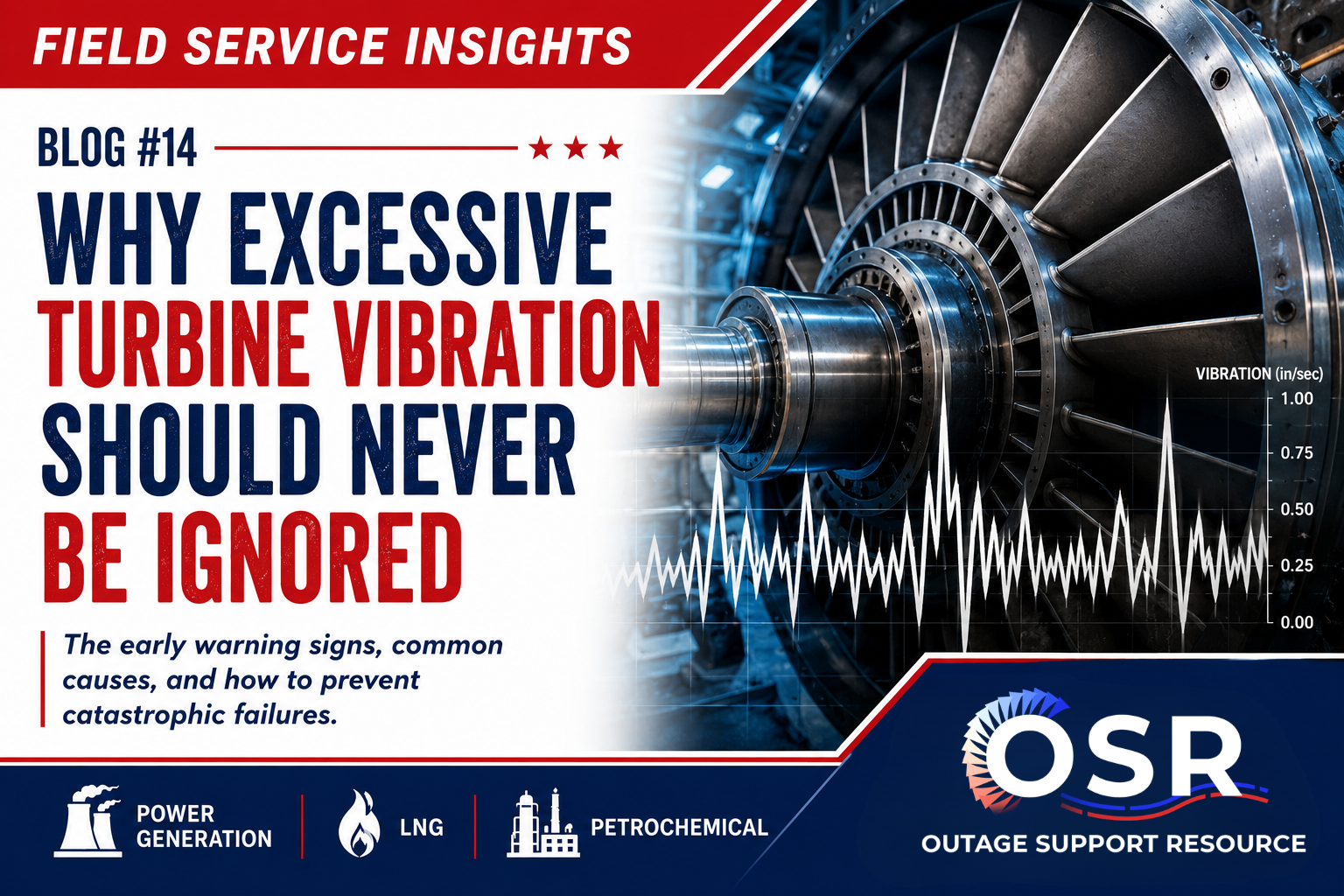
Why Excessive Turbine Vibration Should Never Be Ignored
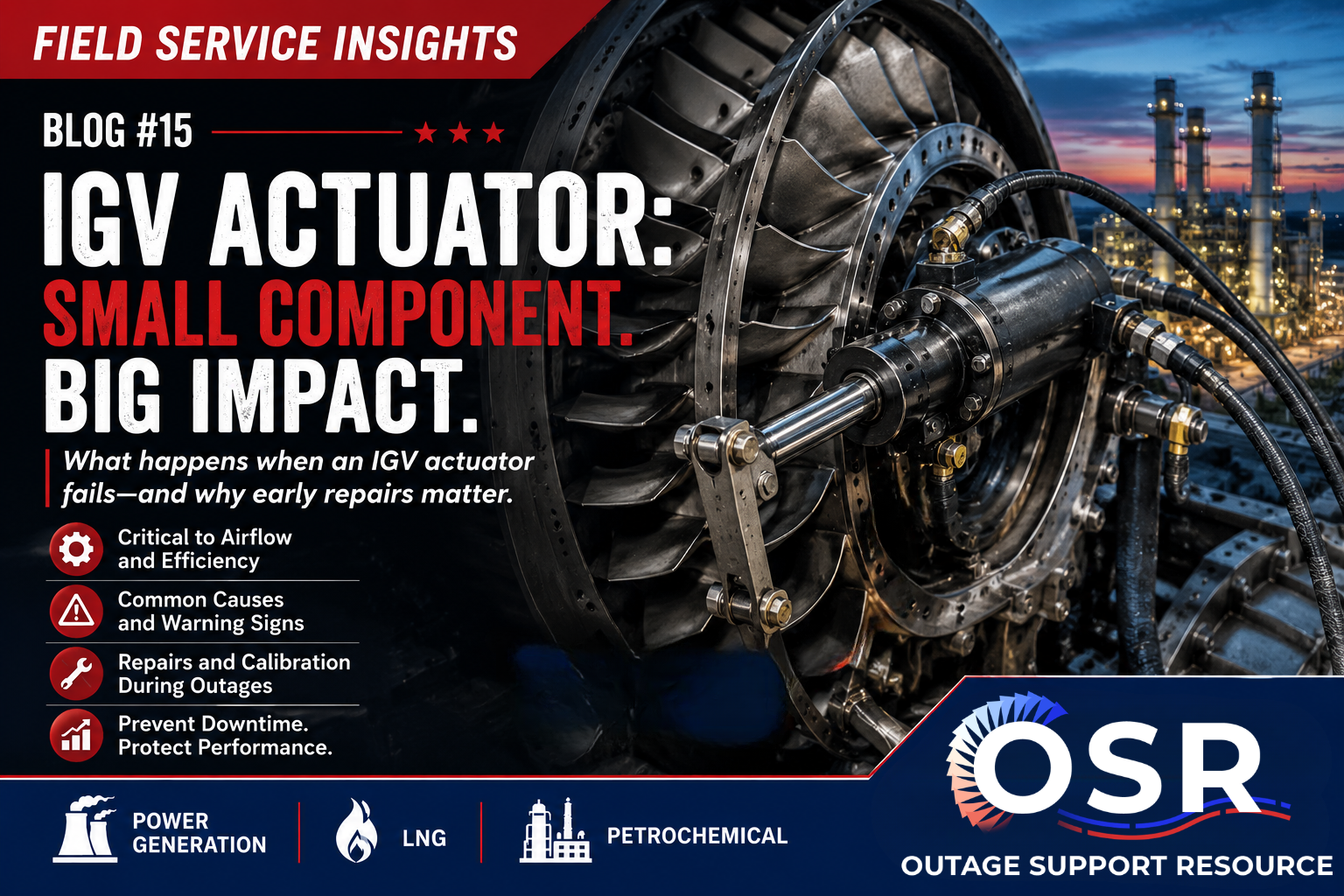
What Happens When an IGV Actuator Fails?
Top Causes of Turbine Failure in Power Plants
Need Turbine or Outage Support?
When unexpected turbine conditions are discovered during an outage, schedule and execution matter.
OSR provides experienced field service and millwright support for power generation, LNG, and petrochemical facilities—from planned maintenance and turbine inspections to emergent repairs and major outage execution.
If it turns, burns, or leaks… we're the solution.
SEO Keywords: turbine case cracks, turbine casing cracks, turbine case crack repair, turbine casing repair, gas turbine maintenance, steam turbine maintenance, turbine repair services, power plant turbine maintenance, turbine field service, millwright services, power plant outage support, rotating equipment repair, turbine inspection, turbine reliability, emergency turbine repair, power generation maintenance, LNG maintenance, petrochemical maintenance, OSR, Outage Support Resource


Outage Support Resource (OSR) provides expert field service solutions for power plants, LNG facilities, and petrochemical operations. Our services include turbine maintenance, outage planning, millwright services, refinery turnarounds, and emergency field service response.
With experienced crews and rapid mobilization, OSR supports critical infrastructure across the United States and Gulf Coast, helping reduce downtime, improve reliability, and execute outages with precision.
Key Words:
power plant outage planning, turbine maintenance, outage support services, refinery turnaround services, LNG plant maintenance, gas turbine inspection, steam turbine maintenance, generator maintenance services, industrial field service, rotating equipment maintenance, millwright services, outage planning checklist, turnaround maintenance planning, plant shutdown support, forced outage response, scheduled outage services, power generation maintenance, combined cycle plant maintenance, petrochemical maintenance services, reliability engineering, preventative maintenance planning, OSR outage support resource, field service technicians, turbine overhaul support, compressor inspection services