2026 I Inside the Outage: Outage Planning, Turbine Maintenance & Field Service Insights Blog
Inside the Outage:
Power Generation, People & Industry Insights.
What Happens When an IGV Actuator Fails?
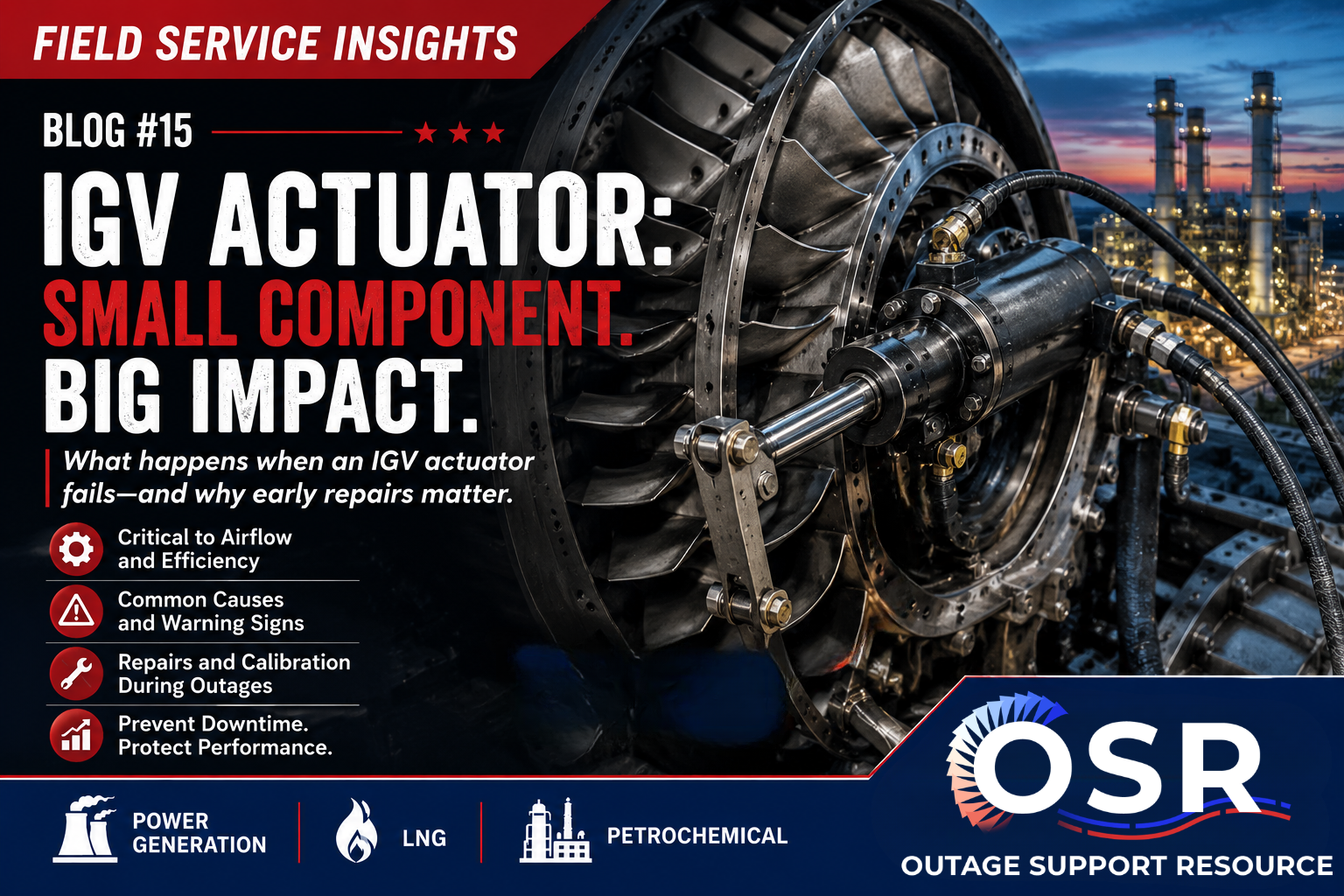
Modern gas turbines depend on hundreds of components working together with precision. While major components like rotors, blades, and combustion systems often receive the most attention, one smaller component can have a surprisingly large impact on turbine performance, the Inlet Guide Vane (IGV) actuator.
When an IGV actuator begins to fail, operators may first notice reduced efficiency, unstable turbine performance, unexpected alarms, or difficulty maintaining load. Left unresolved, actuator failures can contribute to increased maintenance costs, reduced reliability, and even forced outages.
For power plants, LNG facilities, and petrochemical operations, understanding the role of the IGV system is critical to maintaining dependable turbine performance.
What Are Inlet Guide Vanes?
Inlet Guide Vanes (IGVs) are adjustable vanes located at the front of many gas turbines.
Their purpose is to control the amount and angle of incoming airflow entering the compressor.
By adjusting airflow, IGVs help:
- Improve compressor efficiency
- Optimize combustion
- Reduce startup stress
- Improve part-load performance
- Maintain emissions compliance
- Protect turbine components
The IGV actuator is responsible for positioning these vanes throughout startup, loading, and normal operation.
Without accurate actuator movement, the entire turbine can operate outside its intended performance range.
What Does an IGV Actuator Do?
The actuator receives commands from the turbine control system and adjusts the position of the inlet guide vanes.
Depending on turbine design, actuators may be:
- Hydraulic
- Electro-hydraulic
- Electric
- Pneumatic
Regardless of design, precision movement is essential.
Even small positioning errors can negatively affect airflow and overall turbine efficiency.
Common Causes of IGV Actuator Failure
Like any mechanical component, actuators wear over time.
The most common causes include:
Hydraulic Leaks
Hydraulic actuators rely on proper fluid pressure.
Leaks can cause:
- Slow vane movement
- Inconsistent positioning
- Complete actuator failure
Hydraulic leaks should always be investigated immediately.
Mechanical Wear
Years of operation gradually wear:
- Pins
- Bushings
- Bearings
- Linkages
- Pivot points
As clearances increase, actuator accuracy decreases.
Contamination
Dust, dirt, corrosion, and degraded hydraulic fluid can interfere with actuator movement.
Routine inspections during outages help identify contamination before it causes failures.
Electrical Problems
Electronic actuators may experience:
- Wiring failures
- Sensor faults
- Position feedback errors
- Controller failures
Electrical issues often create intermittent operating problems that become increasingly difficult to troubleshoot during operation.
Improper Calibration
Following maintenance, actuators must be calibrated correctly.
Incorrect calibration may result in:
- Uneven airflow
- Startup issues
- Reduced efficiency
- Increased emissions
- Compressor instability
Warning Signs of IGV Problems
Many actuator failures develop gradually.
Common warning signs include:
- Reduced turbine output
- Difficulty reaching load
- Slow vane response
- Inconsistent actuator movement
- Control system alarms
- Increased fuel consumption
- Compressor efficiency loss
- Unexpected shutdowns
Recognizing these symptoms early allows repairs to be scheduled during planned outages rather than emergency shutdowns.
What Happens If the Problem Is Ignored?
An improperly functioning IGV system affects much more than airflow.
Potential consequences include:
Reduced Efficiency
Poor airflow causes the turbine to consume more fuel while producing less power.
Increased Mechanical Stress
Incorrect airflow changes compressor loading and places additional stress on rotating components.
Higher Operating Costs
Reduced efficiency increases fuel costs while lowering plant output.
Startup Problems
Actuator failures frequently create startup difficulties because vane position directly influences compressor performance during acceleration.
Forced Outages
Complete actuator failure may prevent safe turbine operation, requiring an unexpected outage for repairs.
How Field Service Teams Repair IGV Systems
Experienced outage teams approach IGV repairs methodically.
Typical work includes:
Complete Actuator Inspection
Technicians inspect:
- Hydraulic cylinders
- Linkages
- Pins
- Bushings
- Bearings
- Mounting hardware
Linkage Repairs
Wear within the linkage system is repaired or replaced to restore accurate vane movement.
Actuator Replacement
When damage exceeds acceptable tolerances, actuators are replaced with properly tested components.
Calibration
After repairs, vane positioning is recalibrated according to manufacturer specifications.
Proper calibration ensures each vane moves smoothly and accurately throughout its operating range.
Functional Testing
Before startup, technicians verify:
- Full travel
- Position feedback
- Response time
- Control system communication
- Repeatability
Only after successful testing should the turbine return to service.
Why Planned Outages Are the Best Time for Repairs
IGV systems are much easier to inspect during planned outages.
With the turbine offline, technicians have better access to:
- Linkages
- Bearings
- Actuators
- Control hardware
- Compressor inlet components
Early inspections frequently identify wear before operational problems occur.
Field Tip
Whenever an actuator is replaced, inspect the surrounding linkage assembly, not just the actuator itself. Worn pins, bushings, or misaligned linkages can quickly damage a brand-new actuator if underlying issues aren't corrected.
Did You Know?
Many turbine performance issues initially blamed on combustion or controls are ultimately traced back to airflow problems created by worn or improperly calibrated inlet guide vane systems.
How OSR Supports IGV Repairs
OSR provides experienced field service support for gas turbine outages throughout power generation, LNG, and petrochemical facilities.
Our capabilities include:
- IGV actuator replacement
- IGV calibration
- Linkage repairs
- Turbine inspections
- Mechanical repairs
- Precision alignment
- Major outage execution
- Emergency field services
Our goal is simple: complete repairs correctly the first time so your equipment returns to service safely and reliably.
Final Thoughts
Although relatively small compared to the rest of the turbine, an IGV actuator plays a major role in overall performance.
Ignoring early warning signs can lead to reduced efficiency, increased operating costs, and unexpected downtime.
Routine inspections, proper calibration, and experienced field execution help ensure your turbine continues operating at peak performance.
When it comes to turbine reliability, precision matters at every level.
Related Reading
- Why Excessive Turbine Vibration Should Never Be Ignored
- Bearing Oil Leaks: Small Problem, Big Consequences
- Top Causes of Turbine Failure in Power Plants
- The Hidden Cost of Improper Turbine Alignment
Need Outage Support?
Whether you're replacing an IGV actuator, planning a combustion inspection, or preparing for a major outage, OSR provides experienced field service teams that deliver safe, precise, and reliable execution across power generation, LNG, and petrochemical facilities.
If it turns, burns, or leaks… we're the solution.



Outage Support Resource (OSR) provides expert field service solutions for power plants, LNG facilities, and petrochemical operations. Our services include turbine maintenance, outage planning, millwright services, refinery turnarounds, and emergency field service response.
With experienced crews and rapid mobilization, OSR supports critical infrastructure across the United States and Gulf Coast, helping reduce downtime, improve reliability, and execute outages with precision.
Key Words:
power plant outage planning, turbine maintenance, outage support services, refinery turnaround services, LNG plant maintenance, gas turbine inspection, steam turbine maintenance, generator maintenance services, industrial field service, rotating equipment maintenance, millwright services, outage planning checklist, turnaround maintenance planning, plant shutdown support, forced outage response, scheduled outage services, power generation maintenance, combined cycle plant maintenance, petrochemical maintenance services, reliability engineering, preventative maintenance planning, OSR outage support resource, field service technicians, turbine overhaul support, compressor inspection services